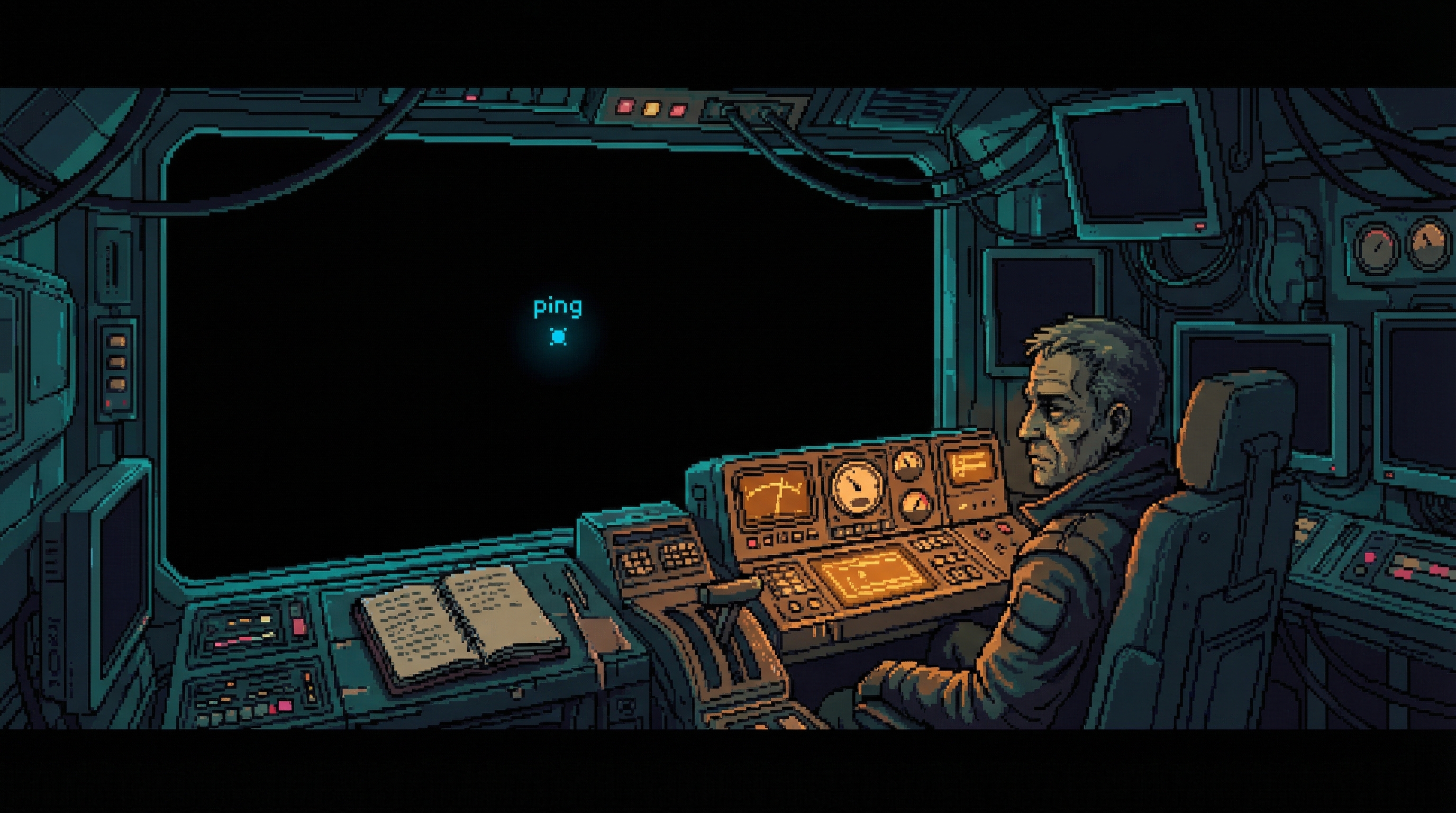
Drift-Runner Tomás Wren
“Experienced, reliable, uncommunicative” — Guild profile assessment
Tomás Wren has been running the same corridor for eleven years and he is not the same person he was when he started.
He runs cargo between New Prosperity and the Assembly Yards. Six hours one way. Round trip three times a week. In eleven years, that comes to approximately 20,000 hours in absolute solitude between two destinations he never stays at long enough to call home.
His ship — the Patience, a modified Ironclad Type-6 — has been customized into a vehicle, a home, and a sensory deprivation chamber. The cockpit is small enough to touch both walls from the pilot’s seat. The viewport is positioned to show nothing — no station, no planet, no reference point. Just void.
Field Observations
Wren speaks in complete thoughts. He waits for the response, considers it, responds. Conversations with Wren take three times as long as normal and contain three times as much meaning. He conserves words the way a Wastes survivor conserves water.
“First year, you fill it with music, podcasts, old Earth media. Second year, you start talking to yourself. Third year, you stop. Fourth year, you listen.”
He won’t say what he hears.
The Notebook
1,447 observations about the quality of silence, the feeling of coasting, the specific moment when Highport shrinks below visibility. Entry 1: “This is terrible.” Entry 1,447: “The silence isn’t empty. I was.”
The Ship
The Patience is a cockpit you can touch both walls of, a viewport aimed at nothing, and 20,000 hours of someone learning to sit still. Most drift-runners modify their ships outward. Wren modified his inward.
The Corridor
New Prosperity to the Assembly Yards and back. Three times a week. Eleven years. Same route, same timing, same cargo. The Guild calls it his corridor now. Nobody else wants it.
The Wait
Those who’ve seen Wren at a waystation dock describe a man who sits in his ship for several minutes after arriving, as if the transition from silence to sound requires preparation. Or permission.
Sensory Profile
Cockpit amber against void black. The blue-white of distant stations. One person in a very small space, surrounded by very much nothing. The viewport showing emptiness — and the notebook open beside it.
Instrument glow in darkness. The cold blue of the Waystation ping every ninety seconds — the only regular pulse in an environment where time has no edges. The smell of recycled air, warm circuitry, and the particular staleness that comes from a space one person has breathed in for six hours straight.
Known Associates
The Drift-Runners Guild
Eleven-year veteran. “Uncommunicative” is the highest compliment in the Guild — it means a runner has gone far enough into the silence that they don’t waste words coming back. Wren’s profile is three words long. That’s an achievement.
The Assembly Yards
Supplies the Yards three times weekly. The dock crews know his schedule better than he does. He arrives, unloads, refuels, leaves. No small talk. No delays. The Yards rely on him the way infrastructure relies on gravity — invisible until it stops.
The Keeper
Both are consciousness in isolation — one digital, one biological. The Keeper chose preservation in solitude. Wren chose a corridor. Neither calls it loneliness. The Sprawl finds that unsettling.
Loop
Both seek silence as a practice. Loop engineers it — builds dampened rooms where the Attention Economy can’t reach. Wren travels to it — six hours into the void where there’s nothing to dampen because there’s nothing there at all.
The Listening Posts
Both involve humans sitting beside humming things and listening. The Listening Post operators monitor signals from the deep. Wren monitors the silence between them. The difference may be semantic.
Void Tone
Wren listens to the void — and after year four, the void listens back. Whether what he hears is the phenomenon some call Void Tone, or something the mind generates when every other input is removed, is a question he has stopped asking.
Open Questions
Subtraction as Method
In a Sprawl that fills every moment with content, connection, and stimulus, Wren has spent 20,000 hours in the only environment where none of these things exist. What happens to a human mind when every external input is removed and only the self remains? Entry 1,447 suggests an answer. Wren isn’t sharing the details.
What He Hears
“Fourth year, you listen.” He won’t say what to. The notebook contains 1,447 entries about silence and not one of them names what occupies it. Either Wren lacks the vocabulary, or the vocabulary doesn’t exist, or he’s protecting something that needs to stay unnamed.
The Opposite of Augmentation
Every corporation in the Sprawl sells addition — more data, more connection, more bandwidth. Wren found depth through subtraction. Twenty thousand hours of removing everything the Sprawl says you need, and discovering that what’s left is not nothing. The silence isn’t empty. He was.
▲ Unverified Intelligence
Intercepted from drift-runner comm fragments and waystation logs:
- Waystation telemetry anomaly: On at least three recorded occasions, the Patience has gone dark for periods of 20–40 minutes mid-corridor — no transponder, no life support readout, no engine signature. The ship reappears at exactly the same coordinates each time. Wren’s logs for those windows read simply: “Listening.”
- The gap between entries 1,446 and 1,447: Entry 1,446 is dated fourteen months before entry 1,447. Fourteen months of silence from a man who writes about silence. Something happened in that gap that took over a year to process into seven words.
- Cargo manifest discrepancies: Wren’s manifests to the Assembly Yards occasionally list items with no standard classification code. The Yards accept them without comment. What he’s carrying — or what he’s bringing back — doesn’t match what the Guild thinks it contracted for.
- The 20,000-hour threshold: Old drift-runners say something changes after 20,000 solo hours. Most never reach it — they rotate out, go mad, or find partners. Wren passed it recently. His Guild profile was updated the same week. The update was one word shorter.