Quiet-Under-Growing-Things
Seven-Speak name · Age 12 · Bunker 7741
In Bunker 7741, there is a child who will not leave.
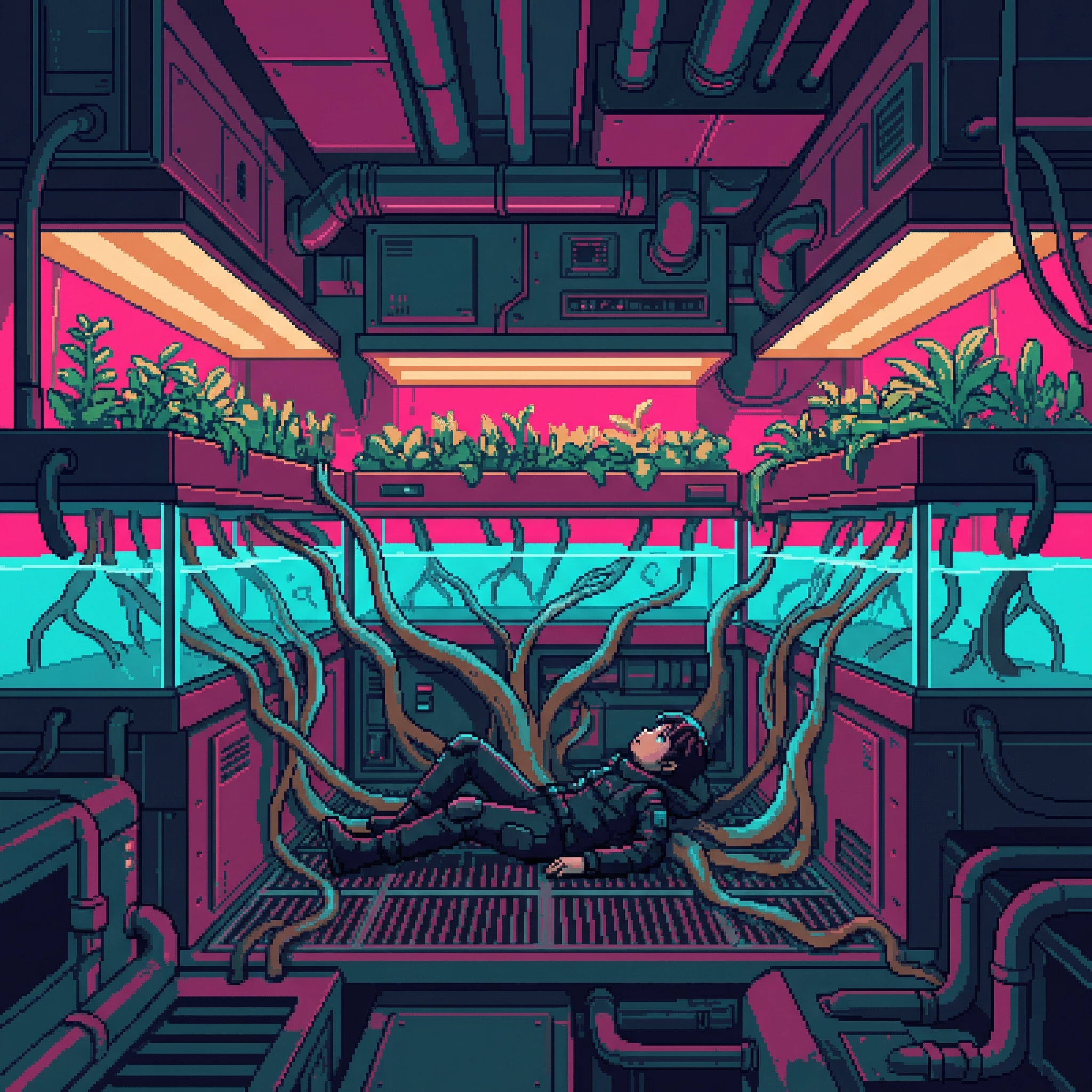
She is 12 years old. Her Seven-Speak name translates to “Quiet-Under-Growing-Things” — a reference to the hydroponic garden where she spends most of her time lying beneath growing beds, looking up through roots and water into grow lights that simulate a sun she has never seen.
She draws. Her art depicts scenes from 7741’s daily life: communal meals, council sessions, garden shifts, music performances. Her drawings contain no perspective — no vanishing points, no horizon lines. They are flat, compartmentalized, organized by the bunker’s physical structure. The concept of infinite visual depth does not exist in her artistic vocabulary because it does not exist in her experience.
When asked if she wants to see the sky: “I want to see the next harvest.”
Field Observations
She speaks with the unselfconscious directness of a child who has never considered the possibility that her world might be incomplete. She is curious, creative, and entirely content. Her lack of interest in the sky is not suppression — it is the natural orientation of a mind that has never needed sky to feel whole.
Memory Therapists who have reviewed her drawings describe them as “cognitively complete” — depicting a world that lacks nothing the artist considers real. This is not a clinical euphemism. Her art does not omit the sky. It does not compensate for the absence of the sky. It operates in a cognitive framework where the sky is not a category. The grow-lights above the hydroponic beds are not a substitute for sunlight. They are the light. The only light.
She has been shown photographs of the surface. She categorizes them as art — interesting compositions, unusual color palettes, improbable scale. She does not categorize them as documentation of a real place. This is not denial. It is the rational response of someone whose entire experiential dataset contains no evidence that such a place exists outside of images.
Her name came from where she is most often found: lying on her back beneath the growing beds, watching roots grow through nutrient solution into the amber light above. She has never expressed interest in what is above the light.
The Grow-Light Sky
Her world has a specific color palette: green and amber. Root-shadow and grow-light. The colors of looking up through water at an artificial sun.
The hydroponic garden in Bunker 7741 runs on a 16-hour light cycle. The grow-lights are warm amber — a frequency optimized for photosynthesis, not human comfort, though the effect on human comfort is considerable. The garden is the warmest, brightest, most alive space in the bunker. It is where food comes from. It is where Quiet-Under-Growing-Things spends her days.
Her key symbol — the image that recurs most often in her drawings — is the view from below the growing beds: flat planes of green intersected by root structures, backlit by amber, with water droplets refracting the light into patterns she traces with her fingers on the floor. She draws this view without perspective because there is no perspective to add. The beds are above her. The floor is below. The world is complete.
Known Associates
The Speaker of 7741
Lives in the same community. Shares, or at least does not contradict, the philosophical position that the sealed world is sufficient. Whether the Speaker’s acceptance of the bunker mirrors the child’s or arrives at the same conclusion through entirely different reasoning — the difference between never knowing and choosing not to know — is a question neither has been observed to discuss.
Bunker 7741 — The Silent City
Born and raised inside the bunker. The sealed world is her entire reality — not a limitation she endures but a completeness she inhabits. She has no frame of reference for what the bunker is protecting her from, because she has no evidence it is protecting her from anything.
The Sky-Word
Another 7741 resident who encountered the sky — or at least encountered information about the sky that registered as real. Their experiences provide complementary data: one child for whom the sky is art, another for whom it became something else. The gap between their responses is the gap between two kinds of sealed-world cognition.
Open Questions
The Completeness Problem
Memory Therapists call her art “cognitively complete.” This raises a question that extends beyond one child in one bunker: is a world that lacks nothing the inhabitant considers real actually complete? Or is completeness always relative to the dataset — and if so, is every sealed world complete to those who live inside it? The bunker walls are not a metaphor. They are a literal boundary. But the cognitive boundary may be more interesting than the physical one.
Art Without Depth
Her drawings have no vanishing points. Surface analysts have flagged this as a developmental gap. Memory Therapists disagree. A vanishing point depicts convergence toward infinity — a visual concept that requires experience of distance greater than the longest corridor in 7741. Her art is not missing perspective. It is accurately representing a world where perspective does not apply. The question is whether anyone outside the bunker can see her drawings without projecting their own horizon onto them.
The Next Harvest
“I want to see the next harvest.” She was asked about the sky and answered about food. The response has been filed as evidence of avoidance, of innocence, of philosophical depth, depending on who is reading the transcript. The simplest reading: she was asked about something she does not categorize as real and responded with something she does. The harvest is real. The sky is a photograph. She chose the real thing.
▲ Unverified Intelligence
Filed under: observations that shift meaning depending on the observer’s own relationship to sealed worlds.
- The flat drawings and the Borrowed Life thread — her art depicts a world sustained entirely by artificial systems: grow-lights instead of sun, nutrient solution instead of soil, recycled air instead of wind. Every element of her experienced reality is borrowed from infrastructure that someone else built and maintains. She does not know this. She draws the growing beds the way surface children draw trees — as a natural feature of the landscape. Whether borrowed life is still life, or whether the borrowing changes what it is, depends on whether you believe the child or the infrastructure report.
- The divide she doesn’t know exists — Quiet-Under-Growing-Things sits on one side of a line she cannot see. Above her, a world she categorizes as art. Around her, a world she categorizes as real. The New Divide is not, for her, a political or social boundary. It is a cognitive one — the line between what she has evidence for and what she does not. She is on neither side of the divide because she does not know there are sides.
- The photographs — someone showed her photographs of the surface. The file does not record who, or why, or what response they expected. She looked at them the way she looks at the murals in the communal hall — with interest, with aesthetic appreciation, without recognition. The photographs are still in 7741’s archive. She has not asked to see them again.