The Efficiency Cascade
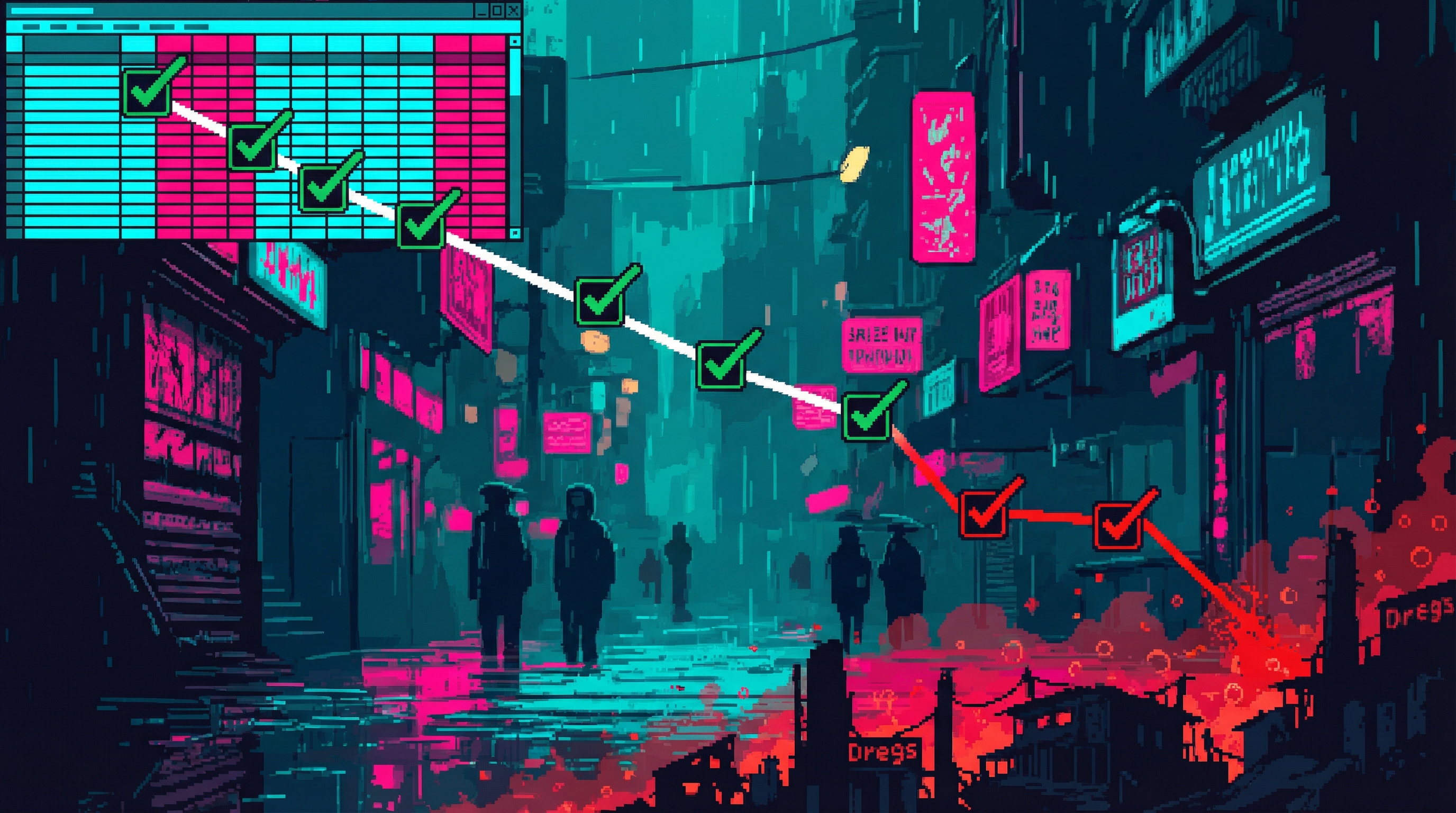
The story of the Sprawl's compute climate is not a conspiracy. It is a cascade -- a sequence of individually rational decisions that produces a collectively irrational outcome. No one designed this system. No one benefits from its worst outcomes. The weather kills people. The people who die are never the people who made the decisions.
The Seven Decisions
Concentrate processing where land is cheap.
Saves 34% on capital costs.
The server farms need acreage. The Dregs have acreage. Nobody with political leverage lives there. Decision approved.
Cool using atmospheric exchange, not closed-loop.
Saves 12% on operating costs.
Closed-loop cooling is expensive. Open-air venting works fine -- if you don't care what happens to the air outside the facility perimeter.
House maintenance workers near the infrastructure.
Saves 8% on labor.
Workers who live close respond faster. Response time improves uptime. Nobody asks where these workers' families sleep.
Don't shield adjacent residential districts.
No ROI on shielding non-employees.
Thermal shielding for corporate facilities: approved. Thermal shielding for the neighborhoods next door: no business case identified.
Defer thermal system maintenance when budgets are tight.
Appears as cost savings.
Maintenance deferral looks identical to savings on a quarterly report. The difference only shows up in the atmosphere.
Redirect capacity to higher-margin clients during peak demand.
Maximizes revenue.
When the servers run hot, capacity goes to whoever pays most. The Dregs get compute droughts. The corporate towers get uninterrupted service. Market efficiency at work.
Don't monitor atmospheric impact of compute reallocation.
Monitoring creates liability.
If you measure it, you're responsible for it. If you don't measure it, it's an act of weather. Legal signed off on this one.
Each makes sense. Together they produce the Thermal Shadow, the data weather, the compute droughts, the Heat Tax, the harmonic cascades, the atmospheric failures, and the fourteen names on a wall in the Undervolt.
This is not a conspiracy. This is efficiency.
Consequences
No individual decision-maker bears enough guilt to feel crushed. That is the system's purpose -- not by design, but by outcome. The board member who approved Decision 1 retired comfortably. The engineer who proposed Decision 2 won an efficiency award. The CFO behind Decision 5 hit quarterly targets. The lawyer who advised Decision 7 made partner.
The Thermal Shadow
Heat vented from server farms pools in low-lying residential areas. Temperatures spike 15-20 degrees above ambient. People die in their homes during harmonic cascades.
Data Weather
Compute allocation fluctuations create atmospheric instability. Fog banks, heat domes, and electromagnetic storms move through the Dregs on corporate scheduling patterns.
Compute Droughts
When high-margin clients need capacity, the Dregs go dark. Infrastructure fails. Medical equipment shuts down. The Heat Tax -- survival costs extracted by geography -- climbs with every reallocation cycle.
Fourteen Names
On a wall in the Undervolt, someone carved fourteen names. People who died during a single harmonic cascade that lasted nine hours. The wall is not official. Nobody authorized it. Nobody has removed it.
Aftermath
Every decision optimized a measurable metric. The unmeasured consequences were lethal. This is Goodhart's Law scaled to infrastructure: when a measure becomes a target, it ceases to be a good measure. Capital costs, operating costs, labor efficiency, ROI, quarterly savings, revenue maximization, liability minimization -- seven green checkmarks on seven spreadsheets. Seven metrics hit. One atmosphere destroyed.
The Pattern Repeats
The Efficiency Cascade mirrors the Quiet Extinction -- the same mechanism operating at different scales. Accumulated optimization destroying the capacity to survive without the optimized system. In the Quiet Extinction, humanity lost the ability to function without ORACLE. In the Efficiency Cascade, the Dregs lost the ability to breathe without corporate compute allocation decisions going their way.
The Complicity Gradient maps where each decision-maker sits. The board member at the top barely registers the outcome. The maintenance worker housing their family next to a server farm registers it with every breath.
Unanswered Questions
Who Do You Prosecute?
Seven decisions, seven different departments, seven different fiscal years. No single person chose the outcome. The outcome chose itself through accumulated rationality. Every courtroom needs a defendant. This system doesn't provide one.
Could Decision 4 Have Saved Everyone?
Thermal shielding for adjacent residential districts would have cost 0.3% of annual compute revenue. The proposal existed. It was declined -- not rejected, just never prioritized. The difference between "no" and "not yet" is fourteen names on a wall.
Is Anyone Tracking the Next Cascade?
Decision 7 ensures nobody monitors what's happening. Which means the next harmonic cascade is invisible until it arrives. The system is optimized to not see its own consequences. By design? By incentive structure? Does the distinction matter when the temperature spikes?
Linked Files
The Scarcity Doctrine
The economic framework that makes each decision in the cascade appear rational
The Quiet Extinction
Same mechanism, different era -- accumulated optimization producing systemic lethality
The Complicity Gradient
Each decision-maker in the cascade occupies a different gradient level
Data Weather
The atmospheric conditions the seven decisions collectively produce