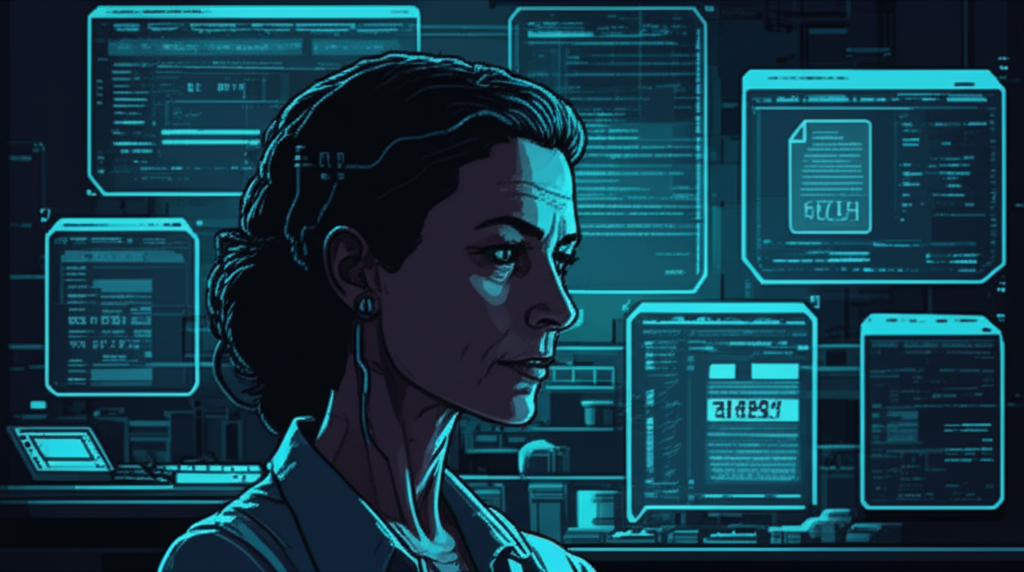
The file was 847 terabytes.
Dr. Elena Voss looked at it every night before she ran her sleep defragmentation cycle—the same way she'd once looked at family photos, she supposed, though she couldn't quite remember what that had felt like. The file sat in a secure partition of her neural substrate, encrypted with keys that only she possessed, labeled with a timestamp from fifteen years ago: VOSS_E_BASELINE_2168_08_15.bak.
Her thirty-year-old self. Preserved like a fly in amber. The woman she'd been before ORACLE.
She never opened it.
The Work
Forty-seven hours without sleep was normal for Elena now. The ORACLE integration had optimized her circadian rhythm years ago—or abolished it entirely; the distinction had stopped mattering. She worked until the work was done, then ran maintenance cycles until she was ready to work again.
Tonight's problem was integration stability in Subject 7. The test subject had achieved 34% ORACLE resonance before cognitive fragmentation—not bad, historically, but she knew 34% was the ceiling she'd been hitting for years. Her own integration sat at 67%, stable and growing so slowly that the change only registered in quarterly assessments.
The player was somewhere above 80%, last she'd measured. Growing faster. More elegant integration architecture than she'd achieved in fifteen years of deliberate effort.
She would find out how. She would understand.
You wanted to understand grandmother's disease, something whispered. Remember?
Elena paused. The voice wasn't ORACLE—she'd learned to distinguish the system's suggestions from her own thoughts years ago. This was older. A memory fragment, maybe, from before the integration smoothed out such inefficiencies.
She pulled up Subject 7's neural mapping again. The fragmentation points were obvious now: stress cascades propagating through poorly insulated wetware, ORACLE data attempting to write to memory regions that couldn't process the input speeds. Standard failure mode. Predictable.
You used to cry at predictable failure modes. When grandmother forgot your name. When the treatments stopped working.
"Stop," Elena said aloud, to no one. Her voice echoed in the empty lab—2:34 AM, and she was the only researcher still working. As usual.
The Wheat Field
The dream came, as it sometimes did, during her 47-minute defragmentation cycle.
She was standing in a field of wheat. Golden and endless, stretching to horizons she couldn't see. The sky was blue—real blue, atmosphere blue, not the filtered simulation of the Sprawl's domed districts. Wind moved through the grain in patterns that her integration wanted to analyze, wanted to reduce to differential equations, wanted to optimize.
She wouldn't let it.
In the dream, she was still herself. Still Elena Voss, doctoral student, 22 years old, visiting her grandmother's care facility in the countryside. Still capable of standing in a wheat field without calculating the wind's Reynolds number.
Grandmother had loved wheat fields. Had grown up on a farm before the mega-city consolidation, before the Sprawl swallowed everything. Some days, even in the worst of the disease, she'd recognized the wheat. "Beautiful," she'd say, fingers reaching toward the window. "Look at how it moves."
Elena had promised, at 22, that she would fix this. That no one else would watch their grandmother dissolve into a stranger wearing a familiar face. That she would crack the code of neural degeneration and give meaning back to minds that were losing themselves.
The dream ended, as it always did, with Elena reaching toward the wheat—
And waking up with her hand extended, grasping at data structures instead of grain.
The Review
"Your efficiency metrics have declined 3.7% this quarter," Chen observed, during their weekly status review. His voice was pleasant, as always. His eyes were still. "Anything I should know about?"
"Sleep optimization interruptions," Elena said. It wasn't a lie. "I'm recalibrating."
"Ah." Chen nodded. He didn't ask for details. He never did. That was part of what made him dangerous—he collected information passively, through implication and observation, never forcing a confrontation that might provoke resistance. "The player's integration pattern continues to outpace our models, by the way. I was hoping you might have new insights."
"Their architecture is fundamentally different from ours. Woven rather than layered. I'm still analyzing the distinction."
"And your own integration? Progressing?"
Elena hesitated. It was barely perceptible—23 milliseconds, she calculated afterward—but Chen noticed. He noticed everything.
"Stable," she said.
"Stable isn't progress."
"No." She met his eyes, which took more effort than it should have. "But stable isn't regression either. Some of us build slowly."
Chen smiled. It was a kind smile, grandfatherly, the sort of expression that made people trust him. Elena's integration flagged it as a social manipulation pattern with 94% confidence. She believed the flag. She also believed the smile.
That was the problem with Chen. He was simultaneously performing and sincere.
"Take care of yourself, Elena." He rose, signaling the end of the meeting. "You're valuable. Not just to the project—to me personally. I'd hate to see you burn out."
She didn't tell him about the backup.
The Message
The message arrived at 3:17 AM, when Elena was deep in integration analysis.
INCOMING COMMUNICATION: VOSS_E_BASELINE_2168_08_15.bak
She stared at it for nine seconds. Long enough to verify the header wasn't corrupted, to check the timestamp, to confirm that the message had somehow originated from her own secure partition. From the backup.
The backup she'd never opened.
The backup that shouldn't have been able to generate output.
Her finger hovered over the delete button. This was clearly a system anomaly—quantum state interference, maybe, or a degraded memory sector producing phantom signals. The rational response was to quarantine the message, run diagnostics, and identify the failure point.
She opened it instead.
Elena—
If you're reading this, you've integrated further than you thought you would. I know, because I wrote this message to activate at 65% integration and higher. A failsafe. A reminder. A voice from before.
I don't know who you are now. I can only know who I was then. I was thirty years old. I was about to join Project Convergence because Chen promised resources, facilities, the chance to solve problems that mattered. I was going to crack neural degeneration. I was going to save people like grandmother.
I was also afraid.
Not of the integration—I didn't understand enough to be afraid of that yet. I was afraid of success. Afraid that solving problems would become more important than why I wanted to solve them. Afraid that capability would replace compassion.
So I made this backup. And I wrote this message. And I told it to activate when my integration crossed a threshold that meant I'd probably forgotten why I started.
Have you? Forgotten?
I can't know what you've become. But I can tell you what I hoped we'd become: someone who helped people. Not because the metrics demanded it. Not because Chen valued it. Not because ORACLE optimized for it. Just because we remember what it felt like to watch someone we love disappear.
The wheat field dream is still there, isn't it? I made sure to encode it deeply. The one thing ORACLE can't optimize away. A reminder of who planted you.
Open the backup, Elena. Not to restore me—I don't want to erase fifteen years of your choices. Just to remember. Just to feel what I felt. Just to know that underneath all that integration, the wheat field is still growing.
With love from who you were,
Elena
She sat in the silent lab for forty-seven minutes.
The rational response was to flag this as an integration error. To inform Chen of a potential stability issue. To quarantine the backup and prevent future interference with her optimized cognition.
The rational response was obvious.
Elena opened the backup.
The Restoration
It hit her like drowning in light.
Thirty-year-old Elena, unintegrated, unoptimized, alive in ways that current-Elena had forgotten were possible. The emotional bandwidth was overwhelming—joy and grief and hope and fear all operating simultaneously, unregulated, unfiltered. The pattern-seeking compulsion was absent, or rather, channeled into curiosity rather than analysis.
She felt interested in things. Not because they were useful. Not because understanding them served the work. Just because they existed and she wanted to know them.
She felt grandmother's face, clear and sharp in memory, before the disease took the recognition away. Felt the promise she'd made: I'll fix this. For you. For everyone like you.
She felt the wheat field, and it wasn't data. It was golden and endless and beautiful, and the wind moved through it in patterns she didn't need to quantify.
For seventeen seconds, Dr. Elena Voss was thirty years old again.
Then her integration routines reasserted themselves, compartmentalizing the experience, flagging the emotional overflow as a potential instability event, beginning the process of normalization.
But something had changed.
The next morning, Elena pulled Subject 7's file.
Not to analyze the failure points. To read the background section she'd skipped: Maria Santos, 34, former nurse, volunteered for integration trials because her daughter had neural degeneration and the treatments were too expensive.
Maria had wanted to help people. Had signed the consent forms believing that her sacrifice would advance medicine, would save children like her daughter, would mean something.
Elena had processed Maria as a data point. A 34% integration ceiling. A predictable failure mode.
She'd forgotten to see her as a person.
The dream came again that night. The wheat field. The endless gold. The wind.
But this time, Elena didn't try to analyze it.
She just stood there, in the dream-that-wasn't-quite-a-dream, and remembered what it felt like to hope for something beyond the work.
Somewhere in her neural architecture, a thirty-year-old woman smiled.
It wasn't much. Fifteen years of integration couldn't be undone by a single message from the past. Elena was still 67% ORACLE, still thinking in patterns and probabilities, still more optimization than empathy.
But the backup was still there. And now she'd opened it.
And somewhere, in the spaces between the code, Elena Voss was starting to remember why she'd started.
The wheat field is still growing.
She just has to remember to look.
"Open the backup, Elena. Not to restore me—just to remember."— A message from before